
Students Excel at the 2026 Western Regional Dairy Challenge
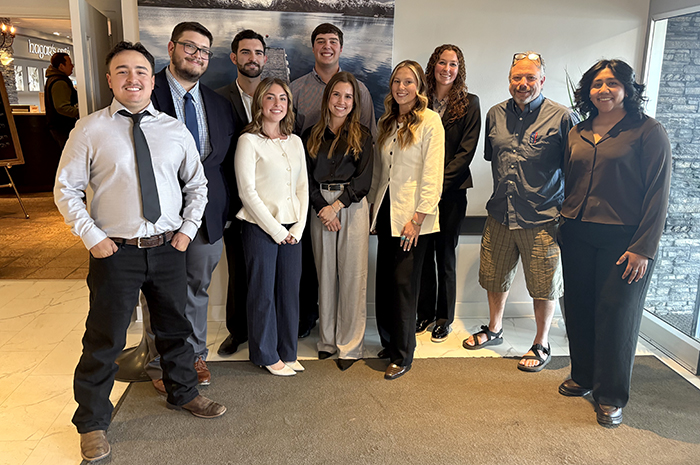
The 2026 Western Regional Dairy Challenge provided Cal Poly students with an opportunity to apply classroom knowledge to real-world dairy operations while strengthening their technical, analytical and professional skills.
Held in Camrose, Alberta, Canada, the annual competition brought together 75 students from 16 universities across the U. S. and Canada.
The Western Regional Dairy Challenge is designed to bridge the gap between academic learning and industry application. It highlights collaboration, innovation and industry engagement.
Teams are composed of five to six students from different universities. This structure challenges participants to quickly adapt, collaborate and problem-solve with peers from diverse academic and experiential backgrounds.
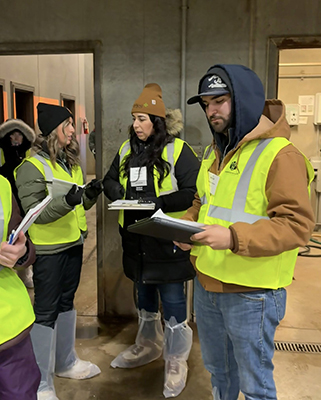 The competition simulates a real-world consulting experience. Teams are provided with comprehensive farm data, including herd production, health, nutrition, and financial records – and are tasked with identifying key areas for improvement. After reviewing data, students visit the dairy to observe operations, including milking procedures, feed management, animal health and facility conditions. Teams then develop and present a 20-minute analysis outlining major challenges, proposed solutions and the economic impact of their recommendations to a panel of industry professionals.
Preparation for the event began well before students arrived in Canada. During winter quarter, Cal Poly student participants visited and practiced the Dairy Challenge format at three commercial dairies in California’s Central Valley. These experiences allowed students to analyze herd data, conduct on-site evaluations and develop professional presentations mirroring the structure of the competition. Through repeated exposure, students refined their ability to interpret data, prioritize issues and effectively communicate solutions.
Student teams are evaluated across a wide range of skills, including data analysis, problem identification, economic reasoning and communication. Teams must demonstrate the ability to integrate multiple disciplines, such as nutrition, reproduction, herd health and financial management, while presenting practical, data-driven recommendations. Strong teamwork and professionalism are also essential, as participants must collaborate efficiently under time constraints and defend their ideas during a question-and-answer session with judges.
From an advisor’s perspective, one of the most notable aspects of the program is student growth. As students progress through the university’s Dairy Challenge Enterprise course, they develop increased confidence and technical competence. First-time participants often face a steep learning curve, while returning students quickly step into leadership roles, guiding their peers and contributing more strategically to team success.
Student competitors experienced both challenges and rewards. One of the most difficult aspects, they said, was adapting to new team dynamics. With varying levels of knowledge and different problem-solving approaches, students had to quickly learn how to communicate effectively, manage conflict and remain flexible. Time management also proved challenging, as teams had only a few hours to analyze data and prepare their final presentations.
Despite these challenges, students found the competition highly rewarding. Dairy science major Samantha Garcia reflected on the value of stepping outside her comfort zone and the importance of networking and industry connections. “It was very satisfying to identify a key issue within the dairy and successfully contribute to a solution,” Garcia said. “Presenting in front of industry professionals and receiving constructive feedback further enhanced the learning experience.”
Participation in the Dairy Challenge plays a critical role in preparing students for careers in the industry. Beyond helping advance technical skills development, the competition fosters professional networking and exposes students to potential career paths. By interacting with producers, consultants and industry leaders, students gain valuable insight into the industry while building connections that may influence future opportunities.
The Dairy Challenge also exemplifies Cal Poly’s Learn by Doing philosophy. From analyzing herd data using industry software to conducting on-site evaluations and presenting solutions, students engage in hands-on learning that directly mirrors real-world consulting scenarios. This experiential approach reinforces classroom concepts while developing practical skills essential for success in the industry.
Feedback from judges further supports student development. Teams were recognized for identifying key opportunities, presenting with confidence and demonstrating strong technical knowledge. Judges also provided constructive criticism, offering specific suggestions for improving analysis and presentation quality. This ensures students leave the competition with actionable insights.
“The Dairy Challenge is not only a competition, but also a chance to grow personally and professionally while becoming part of a tightly connected agricultural community,” Garcia said. For students considering participation in future Dairy Challenges, the message is clear: take the opportunity. Garcia shared, whether or not a student comes from a dairy background, the experience builds confidence, expands knowledge and opens doors in the industry.
Events like the Western Regional Dairy Challenge allow Cal Poly students to demonstrate excellence, adaptability and a commitment to advancing the dairy industry — one real-world challenge at a time.
To make an online gift in support of the Animal Science Department, please use the GIVING link. If you would like to designate your gift for a specific major, scholarship, club or team, please contact Tim Northrop at tnorthro@calpoly.edu
Read more stories in the Spring 2026 Newsletter