
Cal Poly and Oregon State Student Researchers Explore How Cows’ Milk Shapes Beef Cattle Feed Efficiency
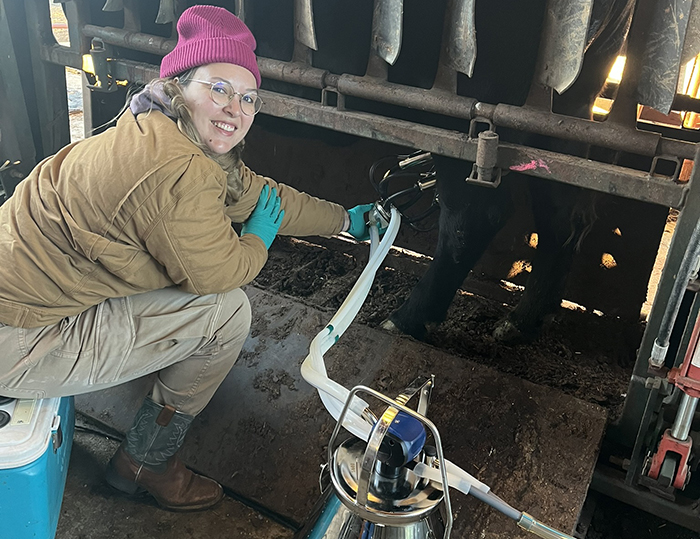
A collaborative research project between Cal Poly and Oregon State University is exploring how microbes transferred through a cow’s milk may influence calf development, feed efficiency and greenhouse gas emissions in beef cattle.
The project is led by Cal Poly animal science faculty member Zach McFarlane in partnership with researchers at Oregon State University. Funding is provided by the California State University Agricultural Research Institute (CSU ARI), with matching support from the U.S. Department of Agriculture’s National Institute of Food and Agriculture (NIFA) through its Capacity Building Grants for Non-Land-grant Colleges of Agriculture program.
The study focuses on the rumen microbiome – the community of microorganisms that enables cattle to digest feed. Researchers are investigating whether microbes passed from a cow to her calf through milk help establish that microbiome early in life, potentially influencing how efficiently cattle convert feed into growth and how much methane they emit. Previous research in dairy cattle suggests that more feed-efficient cows have distinct milk microbiomes. However, this relationship has not been explored in beef cattle.
Feed efficiency remains a key factor for beef producers, as it determines how effectively cattle convert feed into marketable product. Identifying biological drivers of efficiency could inform future breeding and management decisions.
“This collaboration strengthens the data because of the different production environments and genetic backgrounds of the respective university cattle herds,” McFarlane said. “Oregon State has equipment to monitor greenhouse gas emissions, while the Cal Poly Bull Test program allows us to track feed efficiency. Both metrics are critical, and we are interested in whether the milk microbiome establishes feed efficiency early in life.”
The study includes 12 cows from Cal Poly’s purebred Angus herd at the university’s Peterson-Serrano Ranch. The animals were selected specifically because their bull calves will eventually enter the Cal Poly Bull Test program.
Cal Poly student researchers are tracking calves throughout the production system, from birth through performance testing. Milk samples were collected at two key stages: just before the breeding season during peak lactation and again at weaning, when calves transition to the feed efficiency test.
To estimate milk production, students used a modified weigh-suckle-weigh method, a common approach for evaluating lactation in beef cattle. Cows and calves were separated for 12 hours, after which cows were milked using a portable milking machine to estimate 24-hour milk yield. Following the procedure, cows and calves were immediately reunited.
Milk samples were analyzed by the Central Counties Dairy Herd Improvement Association for quality characteristics such as fat and protein content. Student researchers also collected rumen fluid samples from both cows and calves to assess whether microbial transfer occurs between dam and offspring.
After weaning, the bull calves will enter the Cal Poly Bull Test, where their performance is compared with approximately 130 bulls from ranches across the western United States. Using the SmartFeed system, students track individual feed intake, feeding behavior and average daily gain to calculate feed efficiency.
Meanwhile, researchers at Oregon State are collecting greenhouse gas emissions data using the GreenFeed system, which measures methane output from cattle. Together, the institutions are working to determine whether a specific microbiome associated with feed efficiency can be established through milk consumption early in life.
“The intention of this research project is to investigate the link between the maternal microbiome and calf development,” said animal science student Safia Haq. “With new insights into this relationship, we can better understand how feed efficiency may be influenced by the microbes calves acquire through nursing.”
The project also addresses a gap in available data. Milk characteristics in modern Angus cattle are rarely measured, leaving limited and often outdated information.
“It is not a common production practice to milk beef cows,” Haq said. “By testing milk from modern Angus cows, we’re collecting new information that is not widely available in the industry.”
Undergraduate students play a central role in the research, conducting fieldwork and assisting with data collection and analysis. Their responsibilities include sorting cattle, operating chutes, collecting biological samples, and maintaining detailed records.
Students have gained hands-on experience using milking equipment, administering oxytocin to induce milk letdown and collecting rumen fluid samples (procedures not typically performed in beef cattle systems).
To make an online gift in support of the Animal Science Department, please use the GIVING link. If you would like to designate your gift for a specific major, scholarship, club or team, please contact Tim Northrop at tnorthro@calpoly.edu
Read more stories in the Spring 2026 Newsletter